Quick answer
Seal the gaps first (door sweep, weatherstripping, acoustic caulk), then add mass where sound gets through (a solid-core door, window inserts, an extra layer of drywall), and add soft surfaces to cut echo inside. The cheap fixes make most rooms noticeably quieter. True soundproofing needs construction, and professional jobs typically cost $1,000–$3,000 (HomeGrail).
Table of contents
Soundproofing vs. sound absorption: know which one you need
These two get mixed up all the time, and it’s why many people buy the wrong product.
- Blocking (soundproofing) stops sound from getting into or out of a room. It depends on mass and airtight construction. Its rating is STC (Sound Transmission Class): the higher, the better a wall or door blocks sound.
- Absorbing (acoustic treatment) reduces echo inside the room. Its rating is NRC (Noise Reduction Coefficient), from 0 to about 1. Acoustic panels often score around 0.80–1.00, while drywall and glass are around 0.05 (Acoustical Solutions).
In practice: if you hear your neighbor, traffic or the TV in the next room, you need blocking. If your own room sounds echoey on calls, you need absorption. Acoustic panels alone will not keep outside noise out.
Step 1: Find where the noise gets in
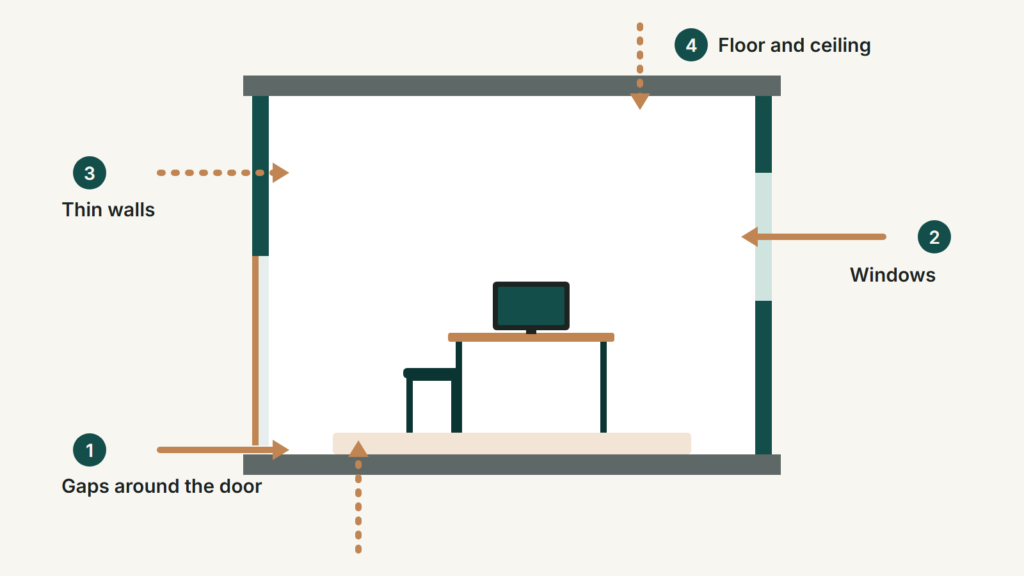
Sound takes the easiest path, so a small gap can matter more than a whole wall. Check the four usual paths:
- Gaps around the door, especially the gap at the bottom
- Windows, through thin glass and leaky frames
- Thin walls, especially shared walls
- The floor and ceiling, in apartments and multi-story homes
Quick test: at night, turn off the lights in the room and shine a flashlight around the door frame from the other side. Where light gets through, sound gets through. Then stand still at the noisiest time of day and listen at the door, the window and each wall.
Step 2: Cheap fixes (mostly under $100)
Start here. These are renter-friendly and often make the biggest difference for the money.
- Door sweep: closes the gap under the door. Adhesive and screw-on sweeps usually cost under $20 at hardware stores (October 2026).
- Weatherstripping: foam or rubber strips around the door frame and window sashes seal the side gaps.
- Acoustic caulk: seal small cracks around trim, outlets and window frames.
- Heavy curtains: thick, lined curtains help a little with window noise and a lot with echo.
- Rug with a thick pad: reduces footstep noise and echo, especially on hard floors.
- Full bookcase on the shared wall: adds some mass and breaks up sound reflections.
- White noise or a fan: doesn’t block sound, but masks it, which can be enough to focus or sleep.
Step 3: Mid-range fixes ($100–$1,000)
When the cheap fixes aren’t enough, add mass and seal properly:
- Swap a hollow-core door for a solid-core door. In one acoustics supplier’s tests, standard hollow-core interior doors rated STC 24–32, solid-core doors STC 32–36, and acoustic doors with seals and a sweep STC 40–45 (Commercial Acoustics). Even a good door leaks sound through gaps, so seal it too.
- Add perimeter door seals (an adjustable gasket kit around the frame) along with the sweep.
- Window inserts: a second pane fitted inside the existing window frame adds an air gap and mass. This is often the best fix for street noise when you can’t replace the windows.
- Acoustic panels: for echo inside the room, not for outside noise. Place them at the first reflection points (the side walls next to your desk) and behind you on calls.
Step 4: Serious fixes ($1,000 and up)
These need construction and are best for homeowners, home studios and rooms you’ll use for years.
- Fill the wall cavity with insulation. Batt insulation in a stud wall raises its rating by a few STC points.
- Add a second layer of drywall, ideally with a damping compound between the layers.
- Decouple the wall with resilient channel, so sound can’t travel straight through the studs.
- Room-within-a-room: a separate inner wall and ceiling, used for recording studios.
How much each upgrade helps a typical wood stud wall with 5/8″ drywall, according to an acoustics supplier’s reference table (Commercial Acoustics):
| Wall build (wood studs, 5/8″ drywall) | STC rating |
|---|---|
| One layer each side, no insulation | 33 |
| One layer each side, batt insulation | 36–39 |
| Two layers on one side, batt insulation | 41–44 |
| Resilient channel on one side, two layers, insulation | 48–52 |
| Resilient channel on both sides, two layers, insulation | 52–56 |
Real-world results are usually a few points lower than lab ratings; the same source says field performance runs 3–5 points lower.
How much does it cost to soundproof a room?
| Project | Typical cost | Source |
|---|---|---|
| Cheap DIY fixes (sweep, weatherstripping, caulk) | under $100 | Hardware store prices, October 2026 |
| Typical professional job | $1,000–$3,000 (average about $1,850) | HomeGrail, Jan 2026 |
| Home office | $1,000–$2,500 | HomeGrail |
| Per square foot: basic / intermediate / full | about $10 / $15 / $30+ | HomeGrail |
| Mid-range residential projects | about $6–$12 per sq ft | Soundproof Cow, May 2026 |
Labor is usually the biggest part of a professional job, so the cheap and mid-range fixes you can do yourself go a long way.
Renting? Soundproof without construction
Everything in Step 2 works for renters, plus:
- Door draft stoppers that slide on and off the door
- Freestanding bookcases instead of wall changes
- Acoustic panels hung with removable strips
- Window inserts that press into the frame without screws
- A thick rug and pad under the desk
Check your lease before drilling or replacing a door.
What doesn’t work
- Egg crates and thin foam: they don’t block sound and barely absorb it.
- Acoustic panels for outside noise: they reduce echo, not noise coming in.
- “Soundproof” paint: at best a small change; it can’t replace mass or sealing.
- Fixing one wall but ignoring the door: sound takes the weakest path.
FAQ
Can you soundproof a room cheaply?
You can make a room much quieter cheaply by sealing gaps: a door sweep, weatherstripping and acoustic caulk usually cost under $100 in total. Fully blocking loud noise needs construction.
How much does it cost to soundproof a room?
Professional jobs typically cost $1,000–$3,000, with an average around $1,850, or roughly $10–$30+ per square foot depending on how complete the work is (HomeGrail).
Do acoustic panels soundproof a room?
No. Panels absorb echo inside the room. To keep outside noise out, you need to seal gaps and add mass.
How do I soundproof a room from outside noise?
Start with the window: seal the frame, hang heavy curtains, then add a window insert if traffic noise is still a problem. Seal the door gaps too, because sound often comes in through more than one path.
How we researched this guide
We compared acoustic ratings published by acoustics suppliers, cost data from home-improvement cost guides and current hardware store prices, and cross-checked claims across sources. We haven’t measured these fixes in our own rooms, and no brand paid to be included. Our editorial policy →